Introduction
The accuracy of analysis and testing depends not only on the performance of the measurement instrument, but also and more importantly on sample preparation. This is a principle that applies to all testing methods. For this reason, many analysis and testing instruments are supplied with various auxiliary sample preparation accessories. At NETZSCH, these include a mechanical press for DSC, a sample cutter for STA, a sputter coater for LFA, and even many other analysis and testing methods techniques beyond our field of thermal analysis, such as an ion-thinning machine for SEM and polishing machines for metallographic microscopy, etc. In many cases, sample preparation and pretreatment are far more critical than the testing process itself. In this Application Note, we will explore how our Kinexus rotational rheometer can assist with sample preparation before rheological testing.
Here, we examine the preparation and rheological testing of freeze-thaw polyvinyl alcohol (PVA) hydrogels. PVA, a hydrophilic, biodegradable and biocompatible synthetic polymer, has been widely used in various areas of the biomedical field. PVA allows for the formation of physical cross-linking during freeze-thaw cycling without any need for the potentially toxic monomers used in typical chemically cross-linked gels [1,2]. The conventional method of preparing freeze-thaw PVA hydrogels involves repeatedly freezing and thawing the PVA solution, which is extremely labor-intensive and expensive. This paper introduces a method for directly preparing freeze-thaw PVA hydrogels using a Kinexus rotational rheometer.
Experimental and Results
Preparation of a PVA Solution
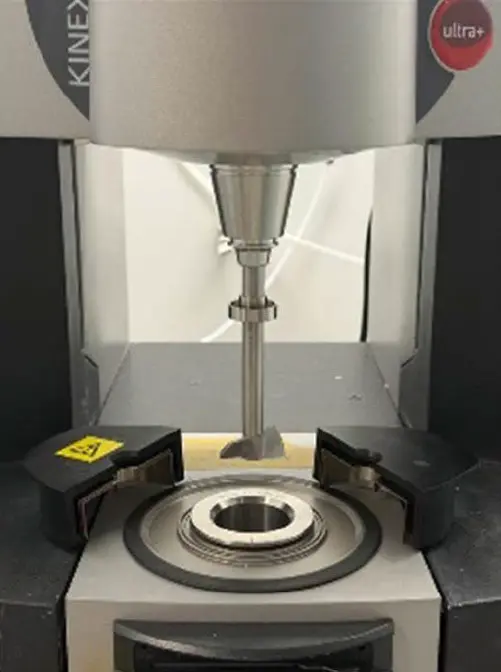
To prepare a PVA solution, add a defined mass fraction of PVA particles into water at 80°C and stir until it is completely dissolved to form a uniform solution. For this, a universal adapter can be used along with a stainless steel stirring blade, and a 34-mm diameter cup. At the same time, a solvent trap system can be used to suppress water evaporation during dissolution and stirring. The combination of accessories used shown in figure 1.
Here, we prepared a 15wt% PVA solution. Weigh 6 g of PVA particles (CAS: 9002-89-5, Mw: 61000) and 34 g of deionized water; pour the water into the cup, then heat it up to 80°C using our Kinexus rotational rheometer at a stirring speed of 50 s-1. Slowly add the PVA particles into the cup for 5 minutes (to prevent them from sinking to the bottom and affecting the dissolution and dispersion speed); stir and dissolve for 40 minutes to obtain a uniform PVA solution, and finally cool it back to 25°C.
Preparation of Freeze-Thaw PVA Hydogel
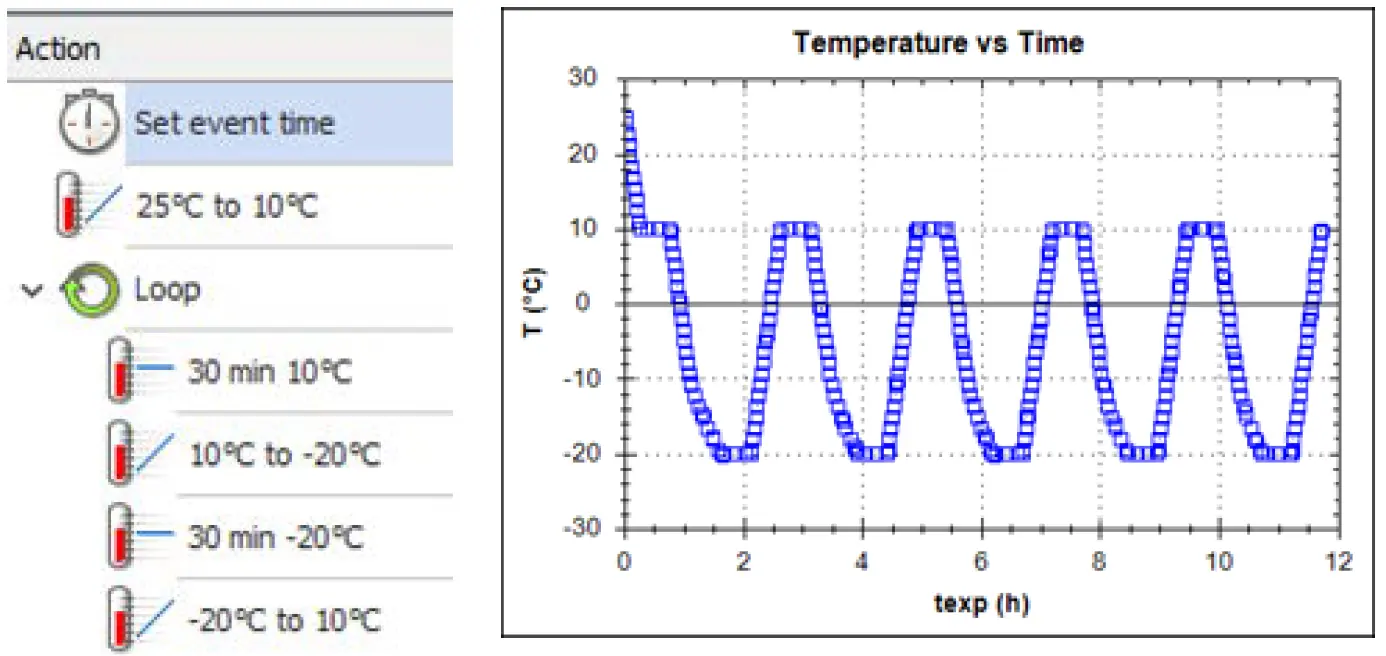
The PVA solution can only form a hydrogel with a certain mechanical strength after several freeze-thaw cycles. The conventional method usually requires expensive labor resources and involves repeatedly putting the PVA solution in and out of a freezer. This freeze-thaw cycle often takes a long time, typically overnight. Therefore, labor costs are greatly increased. By using our Kinexus rotational rheometer, a test sequence for temperature cycling heating and cooling processes can be set directly, and the entire freeze-thaw process can be completed independently, thus saving on manual operating costs.
For example, as shown in figure 2, we set five cycles with each cycle containing four steps: IsothermalTests at controlled and constant temperature are called isothermal.isothermal at 10°C for 30 min; ramping from 10°C to -20°C at 1 K/min; IsothermalTests at controlled and constant temperature are called isothermal.isothermal at -20°C for 30 min; ramping from -20°C to 10°C at 1 K/min. This freeze-thaw temperature program can also be performed in in various geometries to obtain samples of different shapes.
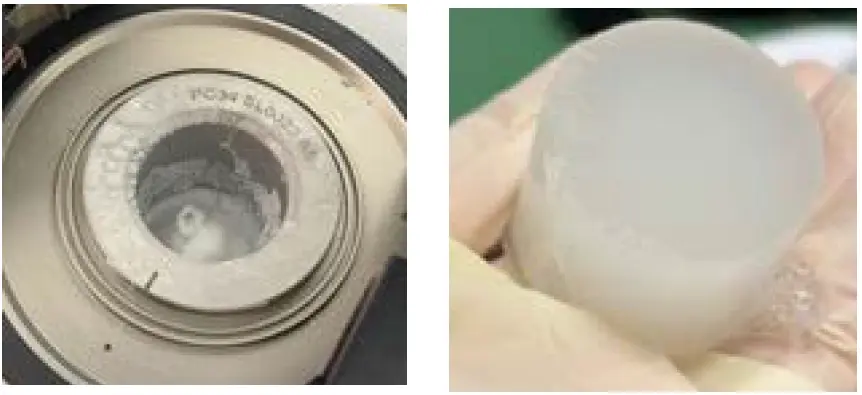
For general tests, we can directly prepare a large block of hydrogel in the 34-mm cup for standby, using the same method as for conventional mold preparation, as shown in figure 3.
Conclusion
In the analysis and testing industry, obtaining accurate and reliable results is of paramount importance. There are many factors that can affect the accuracy of these analysis and testing results. Firstly, the performance of the instrument itself is very important. However, when using a high-performance instrument, the operating techniques and skills become most important. Just like the sample preparation work mentioned here; only perfect sample preparation can yield accurate and reproducible results.
Here, we introduce the freeze-thaw water gel preparation method for our Kinexus rheometer which is applied in a wide range of fields. There are many special sample preparation methods in other industries such as medicine, food, polymers, etc. We are therefore happy to communicate with all of you to use and develop more and better test methods for our Kinexus.